Interview with St. Louis Shakespeare Festival’s Tom Ridgely
I got a chance to meet up with Tom Ridgely, Artistic Director of the St. Louis Shakespeare Festival to discuss the myriad of Shakespeare entertainment options they provide to the community and how they’ve reacted to keeping theatre alive during Covid-19. We also discuss their outdoor holiday event A Walking Xmas Carol, a very creative and fun way they’re serving St. Louis. (More interviews here.)
If you enjoyed this, share it on Twitter or Facebook or copy & forward this link: StLouisShakesfest-HarkJournal
Follow St. Louis Shakespeare Festival here:
St Louis Shakespeare Festival website
Facebook.com: @STLShakesFest
Twitter: @STLShakesFest
Instagram: @stlshakesfest
Youtube: St. Louis Shakespeare Festival
***
If you’d rather read the interview, a rough transcript is below.
Interview with St. Louis Shakespeare Festival Artistic Director Tom Ridgely
Michael Van Osch: Hey, this is Michael Van Osch. Welcome to the Hark Journal. Thanks again for joining us for our interview series. And today I’m really pleased to talk to Tom Ridgely. He’s the producing our artistic director at the St. Louis Shakespeare Festival, Tom, how are you?
Tom Ridgely: I’m great, Michael, how are you?
Michael Van Osch: I’m great. Thanks for joining us. I appreciate it.
Tom Ridgely: Thanks for having me.
Michael Van Osch: How are things going in St. Louis these days?
Tom Ridgely: Well, it’s all relative. that’s for sure. And St. Louis, like everywhere has seen a big spike recently, so things are starting to shut back down a little bit.
But you know, like everyone at the Festival, we’ve been trying to do what we can, with all of the limitations that we’re up against. But it’s certainly unleashed a lot of creativity across the city. And a lot of energy too. So it’s been great to see artists respond, organizations respond and just, you know, regular people step up in a time when it’s needed.
Michael Van Osch: Yeah, for sure. Give me a little bit of a history of St. Louis Shakespeare Festival. Cause I think it started around 2001. Is that right?
Tom Ridgely: It was the first summer. That was a, it started with a production of Romeo and Juliet in Forest Park, which is a beautiful big urban park, right in the middle of St. Louis.
And this past summer was to be our 20th, anniversary season and obviously ended up being quite a bit different than we’d originally imagined it would be. But, it grew from, yeah, from that one Shakespeare in the park production to a pretty year round organization. In addition to a tour that goes all over the region of a smaller scale Shakespeare play.
We also have a program called Shakespeare in the Streets, which works with different communities and neighborhoods around St. Louis over a year or so to gather stories and collaborate with the residents, to tell their story with an adaptation of a Shakespeare play. So a writer and a director work with them to create the play.
And then at the end, a street gets shut down in the neighborhood and a stage goes up and a company and he comes together of professional actors and just regular folks, who live in the neighborhood and people come from all over the region to, you know, to just, to, to a place they might not often visit otherwise, just to, to hear from some of their fellow St. Louisans. And it’s a really beautiful thing.
Michael Van Osch: Wow. Yeah. Great community engagement there. How long have you been doing that?
Tom Ridgely: That program is about eight years old. That was started by my predecessor, Rick Dildine, and our playwright in residence, Nancy Bell. And it’s grown from there. The last one we did was an urban, rural collaboration.
So actually about two neighborhoods, one in North St. Louis and the other in Calhoun County, Illinois. So the play started in, in St. Louis and, and, and then at the intermission we put every, all the audience on buses drove them to a ferry that took them across the Mississippi, under the Illinois side, and the Illinois folks were there welcoming folks with peach cobbler, and everybody sat down and watched act two on the banks of the Mississippi.
Michael Van Osch: That’s phenomenal.
Tom Ridgely: You know, it was pretty cool. That was pretty cool.
Michael Van Osch: That’s amazing. I noticed too, probably maybe due to COVID you tell me, but you’ve got something called Shakespeare TV and you’re doing a lot of things on there too. Tell us a little bit about that.
Tom Ridgely: Well, you know, at the very beginning, when things shut down, we just like everyone had to figure out what, gosh, what are we going to do?
And the only thing you could do then was, was, was take things online and it started with our touring production. We had just kind of gone on road, had been out for a week or two. And, but we managed to get a great recording of it. When we could tell that things were going to lock down. Before that happened, we did that.
And so that was sort of what kicked it off. And over the next three months, we put out 65 new sort of premieres or pieces of content, you know, sort of digital programs. There’s almost one a day. wow. But, and, and I think at the time it was, it was great because we were all holed up in our apartments.
The only way we had to really connect with anyone else - or homes - the only way I had to connect with anyone outside was through, you know, online events. And so that sort of tapered, we haven’t done much of that or any of it since June. Our focus has sort of shifted, but so that’s one of the great questions sort of hanging over arts organizations right now is to what extent will a lot of this zoom theater and online programming, you know, continue and evolve. And, and how much will we all just try to, you know, desperately leap back into the kinds of live events that obviously we’re we are built for.
Michael Van Osch: Would you say there’s, there’s things that you’ve learned through this lockdown period that will aid or enhance what you do going forward. Assuming we get back to normal?
Tom Ridgely: It’s kind of practical things just about how these technologies work and yeah. And about how to reach audiences and how to connect in different ways and new ways. I think the biggest thing we’ve learned is less about like, Oh, here’s how to make digital theater really great.
It’s more about, here’s how we can be adaptable. And here’s how we can continue to question the way we’ve done things in the past and define new ways of doing things. So, yeah. honestly, I, I’m not one, I’m not a great believer that the future of theater lies in some, you know, hybrid form. And so I, I think as soon as we can safely gather again, that’s what we are going to do.
And what people will want to do. but I do think that that we’ve all realized that the sort of habits and patterns that we can just naturally fall into, need to constantly be questioned and that, and that, and our organization is most alive when it is, finding new ways to work and finding new ways to create and new ways to support artists and to encourage artists to create a new ways.
That’s what I think audiences respond to. And that’s what makes the art feel alive.
Michael Van Osch: Yeah, absolutely. And then combine that with all the, the black lives matter and the social injustices that have happened at the same time. And I think, yeah, in my opinion, there’s there is, you know, a new way forward that’s, that’s bigger and more inclusive, that sort of thing.
And I’m sure you guys are working in that area too. We all are.
Tom Ridgely: We all are, and we all should be and should have been, and must continue to be. And I do think that will certainly persist and remain that commitments to finally and authentically opening up our field and our organizations, our art form to make it truly welcoming and inclusive.
And as diverse as we want it to be is that I think more than the legacy of zoom theater, is what we’ll remain once we’re on the other side of, of COVID.
Michael Van Osch: Agreed. And you’ve got such an impressive resume here. I do want to highlight some things here for the folks listening because you have done and do so much.
And so you’ve been the producing artistic director there since 2018, a drama desk, a nominated director. You have developed a presented work at the Public Theater, The Old Globe, Oregon Shakespeare Festival, Hudson Valley Shakespeare Festival, Shakespeare Society, the Red Bull and more. And you’ve worked with Tony nominees, such as Sting and Bill Irwin and others and productions have won many awards, DFW theater critics forum, and ECNY awards as well as been nominated for the CTC Critics Circle and BroadwayWorld Connecticut awards.
And then also you’ve also founded another theater company called Waterwell, in New York, you did that from 2002 to 2018, I believe. And had more than a dozen world premieres of classics, adaptations of classics that were nominated for many awards, including Best of New York City from Village Voice. And I thought one thing really stood out to me too.
I mean, you’re, you would take me forever to read your whole bio here, but you know, it said that you also did an adaptation of Hamlet in a dual language with English and Farsi performed by a company of, predominantly middle Eastern and South Asian actors. Can you highlight that a little bit? That sounds really interesting.
Tom Ridgely: Yeah, that was an incredible experience. it came about the fella. I started water while with is a guy by the name of Arian Moayed. He’s an Iranian-American actor and he played, just played Edgar in Lear at the Public and, you know, kind of gotten bit by the Shakespeare bug and yeah. That bug had bitten me a while ago.
And so we just started trying to find something that we could work on together. And when we started thinking about Hamlet and what it might be, we got really taken with the idea or just by the realization that the, sort of what the kind of crisis that Hamlet experienced of, of how to sort of, you know, honor the past and stay true to himself.
Or, you know, just to figure out a way forward when there were these two competing realities in his mind, really closely mirror the situation in Iran at the turn of the 20th century. And a lot of. Countries, that were, you know, being colonized, whether it was, and Iran never was colonized, but, but the British and a lot of other, actors, got very involved in the region and obviously because of oil and land and, and other things, but, what it became theatrically, was, was really exciting because.
What you had was, you know, you had maybe three fourths of the play was, I would say, in, in Shakespeare’s English and, and another, maybe fifth or fourth of it was in Farsi. you know, when the ghost came to speak to him when, and remind him of who he was. And what the country was. He spoke to him in Farsi and, you know, when Hamlet started putting on his antic disposition.
He would sort of slip in and out of Farsi and, the speech that the first player makes as a sort of demonstration of his quality and, and the play within the play were all in Farsi. And so you got this incredible mixture of cultures and languages. And, and I think for people who didn’t speak Farsi, it was, you know, it, it was powerful, you know, in the way they going to see opera can be, almost a more powerful way to receive a story because it sort of, it bypasses the language parts of our brains and kind of goes straight to somewhere else.
And our hearts and our guts are some way. And the people who did speak Farsi, I think it was really…we heard from a lot of them that said it was just incredible to hear their language spoken and to hear it spoken beautifully. And to hear, you know, great actors and a great story. You know not only spoken in their language and sort of set in their worlds to see their culture and their identity reflected back to them in that way, was something that they weren’t used to seeing in the theater.
And so, that was really gratifying to know that, that it meant something to them in that way.
Michael Van Osch: Yeah, absolutely. That’s very cool. So, let’s go back now to St. Louis Shakespeare Festival and you, you’ve got something coming up this winter called A Walking Christmas Carol. And tell us about that, but maybe tell us about how it came about from something that you did this summer, which was also similar.
So, because this is a just a very creative idea for sure.
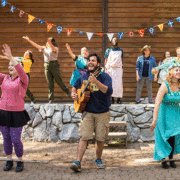
Tom Ridgely: Well, it did grow out of, something similar that we did over the summer. When we realized we couldn’t do our normal Shakespeare in the park, we did something to be called a late summer night stroll, and we took the story and we broke it up into 14 - of A Midsummer Night’s Dream - and broke it up into a dozen or so different moments, scenes, vignettes, and spread those out over about a mile and a quarter in, in Forest Park here in St. Louis.
And in each one of those was sort of marked by a giant art installation, which was sort of replica of our St. Louis Arch. And at each location would be performance. There would be, you know, there would be acting, singing, dancing, comedy, instrumental music. So, to sort of respond to that moment in a different and unique way.
And we worked with this group called Paint It Black STL that had formed in the wake of some of the protests around the killing of George Floyd, by painting over boarded up windows in downtown St. Louis and other places. And their artists created these beautiful art installations, these archways at each stop.
And so, and that really became the coolest thing about the whole project. These were just really striking and, and beautiful pieces of art. And to see these pops of color in the midst of the nature of, of Forest Park was really surprising and delightful for a lot of people. But I think also people were just so happy to be able to get out of their homes and do something safe and outdoors.
That was, that was cultural. That was, you know, was restorative and that just something that felt familiar. It wasn’t anything like any Shakespeare in the park that we’d ever done or that they’d ever experienced, but it was a Shakespeare in the Park. And so people, I think, you know, by the end of the summer just were really hungry for something like that.
And so, you know, when we started looking ahead to the winter and the holidays, we just realized that it for it was going to be a long, hard time, no matter what happened with the election or the vaccine or any of that stuff. And so. Yeah. Obviously we know that a lot of the normal things aren’t going to be happening this year.
There aren’t going to be the Christmas carols and the nutcrackers and the concerts or the office parties or the family gatherings. It’s all going to be very different. So yeah, without all those celebrations, without all of that you know, opportunity to connect, the holidays can be a hard time for a lot of folks in a normal situation.
And we just thought, well, we have to try and do something, that can give folks a chance to celebrate. And so what did is we went to this beautiful neighborhood in St. Louis called the Central West End, which is also a beautiful neighborhood. It’s also, you know, people, it’s a big, great restaurant district.
It’s a high end retail district, but like a lot of places that they’ve suffered some closures. And so there, there are a fair number of empty storefronts. And so we said, well, you know, the one holiday thing that you could do, that’s safe is just go around and take in the holiday windows. And so we worked with Paint It Black again, and some new artists to turn a lot of those empty storefronts into sort of, you know, new 2021 versions or 2020 versions of the old time holiday windows.
But to tell the story of a Christmas Carol, so there’s 21 different art installations and there was an audio companion, which is the Q Brothers hip hop adaptation of a Christmas Carol, which is incredible and brilliant.
Michael Van Osch: They’re amazing, anyone that doesn’t know the Q Brothers, like I didn’t, needs to tune into your website. We’ll put the information in there. They’re amazing.
Tom Ridgely: They are geniuses and just the greatest guys. And we had worked on with them on their adaptation of Two Gentlemen of Verona. I, they’d seen their very first show, which is The Comedy of Errors. They’ve gotten Othello, they’ve got a bunch of different shows.
And their Christmas Carol has been the holiday show for Chicago Shakespeare theater for a number of years as a huge hit for them. But obviously that’s not happening this year. So, we’re partnering with them and. So we’re going to air part of it on the radio here locally in St. Louis, but also people can come and there’s QR codes on the windows, so you can scan it and listen to the track that corresponds to the art that you’re looking at.
And we created a lot of immersive installations all throughout the neighborhood, as well as some live music and, you know, hot cocoa and cocktails and things like that. All outdoors and all obviously, you know, masked and socially distant, but hopefully a safe way for people to come and. And have a little joy and a little lights in our holidays.
Michael Van Osch: Yeah. Sounds great. What are the dates that that runs?
Tom Ridgely: It opens, November 28th, which is Small Business Saturday, and it goes through the 23rd, you know, a big part of it too, was that, you know, obviously local business owners are hurting in a big way and we really wanted to try to, you know, do as much as we could to drive safe traffic their way.
And so, you know, hopefully folks will, will stick around and shop and take advantage of the other things that are open still in the neighborhood.
Michael Van Osch: What a great idea. Looking forward to it. So, I guess all the information will be on the website as if we’re not in St. Louis. We could still tune in and hear some of that on the radio?
Tom Ridgely: So you can check it out on the radio and also where there’s an online map, that’ll have sort of, you know, images of the windows and you’ll be able to kind of you to listen that way. So there is a virtual version, if you don’t want to go out, totally understandable these days. so yeah, STL shakes.org, check it out. It should be pretty cool.
Michael Van Osch: That’s awesome. Well, thank you so much, Tom. I appreciate it. Lots of cool stuff going on, you know, of course, I’ll promote it as much as we can here at Hark and all the best going forward. And hopefully we can get back to some live theater here. I have one final question for you, and that’s what I ask everyone that we, that we interview.
And that is if Shakespeare was on this call with us and you got to ask him one question, what would you ask?
Tom Ridgely: That’s a good one. You know with great artists, the thing that always fascinates me is how they work. And I think with Shakespeare, we just don’t know how he worked. We don’t know when, where he wrote. so I, I, what I’d love to hear from Shakespeare is what’s your writing routine? Did you have one? Was he a late night guy was an early morning guy?
Was he a coffee shop guy? Was he a library guy? You know, where, what were the circumstances that he felt he needed to be as creative as he was.
Michael Van Osch: Produce all that genius work. Absolutely.
Tom Ridgely: If he wrote at the coffee shops. I can do that.
Exactly. What’s the secret Will?
Michael Van Osch: Absolutely. I love it. Well, thank you for that. Stay on the line after we say goodbye here for a second. But everybody, this has been Tom Ridgely producing artistic director at St. Louis Shakespeare Festival. Thanks so much for joining us and, best of luck with the holiday season.
Tom Ridgely: Thanks for having me, Michael, this has been great fun.
Michael Van Osch: Thanks.
Take care.