
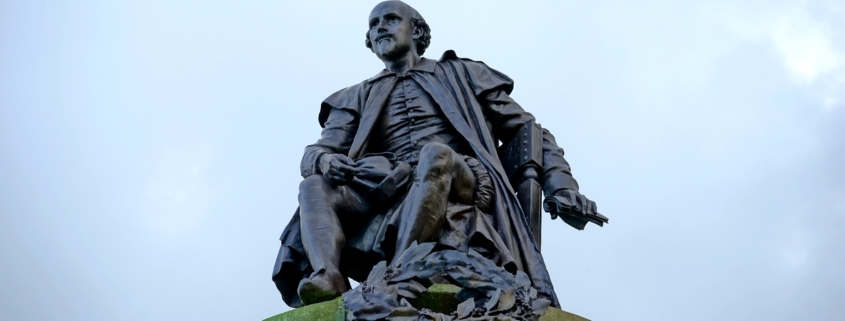
When many people consider William Shakespeare’s biography, they think of a titanic figure of literature, a writer of such status that he comes to embody the national identity of England itself, surely a celebrity of his day. However, during his lifetime Shakespeare was just one of several moderately successful dramatists and writers that collaborated, acted, and worked together in London’s gregarious and vibrant theatre scene to entertain the masses. It was only in later decades that we came to recognize his true genius: his flair for characterization – Fallstaff, Leontes, Romeo - and his ability to turn a phrase: ‘all the world’s a stage’ or ‘all that glitters is not gold’.
Shakespeare’s Biography - The Family
Shakespeare’s life is not a rags-to-riches tale. Indeed, he might often be described as belonging to the early ‘middle class’, often called the ‘middling sort’. His father, John, was a glove maker and a respected member of the local community in Stratford-Upon-Avon, the quaint market town in the middle of England where the family lived.[1] In 1568, four years after Shakespeare’s birth, John was appointed High Bailiff, a position similar to that of Town Mayor. By 1596, he’d been granted a coat of arms, with the motto ‘Non Sans Droict’ or ‘Not Without Right’, cementing his place in English society.[2]
Shakespeare’s mother Mary Arden hailed from the village of Wilmcote, about 3-4 miles north of Stratford-Upon-Avon.[3]Her father, Shakespeare’s grandfather, was a member of the prestigious Guild of the Holy Cross that was highly influential in the wider community.
We don’t know the exact date Shakespeare was born but we do know he was baptized on 26th April 1564. Because St George’s Day is 23rd April and he died on 23rd April, we have traditionally celebrated his birthday on 23rd, though there is no evidence that this is the case.
There’s also no evidence that Shakespeare’s parents could write. They both signed their names with a mark – an X. Stephen Greenblatt argues, John probably did know how to read, as an important gentleman of the town, but not how to write. [4]
Despite not being able to write it’s highly likely that Shakespeare’s parents encouraged his flair for words and sent him to the local grammar school from the age of 7. If he did attend school he likely learned Latin, the language of the upper classes. Shakespeare’s school had just 42 students and school began at 6:00 am in the Winter and ended at 5:30 pm, six days a week; it was surely a grueling experience.[5]
The Lost Years
The greatest mystery of Shakespeare’s biography lies in how he became a playwright. The next record we have of Shakespeare is in 1582 when at age 18 he married Anne Hathaway, 26.[6] The marriage was arranged in haste, presumably due to fact Anne was pregnant with their first daughter, Susanna, and Shakespeare was technically a minor.[7] The couple would have traveled to Worcester to secure the correct license for their marriage.[8]
Yet throughout his wife’s pregnancies, Shakespeare would have been busy working in London trying to make it as a playwright. How he managed this is unclear and we can only speculate as to what impact it had on his relationship with his wife.
It’s reasonable to suggest that Shakespeare first worked as an actor in a troupe before turning his hand to writing, as he would have needed to understand the basics of how a play was put together and worked his way up. The biographer John Aubrey, writing in 1681, suggested that Shakespeare had been ‘a schoolmaster in the country’, though it’s unclear on what information he based this claim.[9] Several theatre troupes visited Stafford-Upon-Avon in the late 1580s so he could have decided to join them.[10]
The ‘Shake-Scene’
The first surviving reference we have of Shakespeare in London is a scathing deathbed critique by fellow playwright, Robert Greene in 1592.[11] Published after his death, in Greenes, Groats Worth of Witt, he wrote of an:
‘upstart crow, beautified with our feathers that his tiger’s heart wrapped in a player’s hide supposes he is as well able to bombast a blank verse as the best of you: and being an absolute Johannes fac totum [Jack of all trades] in his own conceit, the only Shake Scene in a country…’[12]
The lines ‘upstart crow’ and ‘Jack of all trades’ are particularly revealing as they suggest a certain amount of snobbery: Greene, who had a university education objected to Shakespeare – who almost certainly didn’t attend university – writing about the great giants of history.
The lines also reveal that Shakespeare had made a name for himself in London and ruffled some feathers by this point.
Shakespeare and Elizabeth
We don’t know for certain the order in which Shakespeare’s plays were written and performed. Much of the work that has gone into compiling a timeline derives from references in the plays themselves and information from contemporaries that survives, commenting upon the London theatre scene.
However, we can see that Shakespeare’s earliest works focused on the history of England’s great Kings and Queens and other figures in history: Henry VI, parts I-III, Richard II, Julius Caesar, and King John were all written during the so-called ‘Golden period’ of Elizabeth I’s reign when she was at the pinnacle of her power, having defeated the Spanish Armada and the various political plots against her.[13]
Shakespeare’s early plays reflected the jubilant and patriotic mood of the age in which he lived. As he grew more confident, he drifted away from histories and into the more original works for which he is best known such as Romeo and Juliet, The Merchant of Venice, and Much Ado About Nothing.
A notable exception to the patriotic mood of Shakespeare’s earliest plays is his alleged involvement in the so-called Essex Rebellion of 1601. This was when one of Elizabeth I’s most trusted advisers, Robert Devereux, 2nd Earl of Essex, attempted a coup.
On the eve of the uprising, Essex allegedly asked Shakespeare’s company The Lord Chamberlain’s Men to stage Richard II. This was a controversial move because the play centered around the dethroning and eventual death of a real anointed monarch.
But there is a dispute about what play was performed – whether the company did go with Richard II or instead opted for one of the parts of the altogether more innocent Henry IV, about Richard’s successor.[14] There’s also a suggestion that the famous scenes portraying Richard being asked to give up the crown by Bolingbroke, which many historians believe were censored during the Elizabethan period, were reinstated during this particular performance. If this was the case Shakespeare would have been on the verge of committing treason…
What does all this say about Shakespeare’s motives? Was the handsome sum paid by Essex worth the risk of staging the play? Or did Shakespeare have sympathy with Essex and the aims of his rebellion?
Later Years and Collaboration
Never-the-less Elizabeth’s reign was drawing to a close. After she died in 1603, King James VI of Scotland became King of England in a Union of the Crowns changing the dynamic in the country.
Following the Gunpowder Plot of 1605 which shocked the nation, Shakespeare’s work reflected the growing politician tension and unease. King Lear and Macbeth focused on paranoia, madness, and the dangers of tyranny.
His later works were fantastical and other-worldly: Caliban, the monster of The Tempest who haunts an enchanted island and the pastoral romance of The Winter’s Tale which sees Hermione turned into a statue and then reawakened from the dead.
But the most striking thing about Shakespeare’s later years is that he seems to have collaborated on more plays than scholars first thought. Henry VIII is said to be a collaboration with John Fletcher, as is The Two Noble Kinsmen.[15]Computer analysis of Shakespeare’s work has now revealed that he almost certainly had a hand in Thomas Kyd’s The Spanish Tragedy.[16]
Recently scholarship has revealed that Shakespeare didn’t write in isolation. He was just one member of a closely connected set of dramatists and actors in London, living, breathing, and writing together.
How being part of this no doubt rowdy and gregarious literary clique affected Shakespeare’s personal life and his relationship with his wife and children is hard to tell. Did he visit Stafford often? Did he stay faithful or was he a player in every sense of the word? We can gather some glimpses from his will in which he left his second-best bed to Anne – but the bulk of his possessions to his daughter Susannah and son-in-law Thomas Hall.[17]
Shakespeare died in 1616 and was buried at the Parish Church of Stratford-Upon-Avon.[18]
Shakespeare’s Biography - Timeline
1564 – Born around 26th April and baptized at Holy Trinity Church, Stratford-Upon-Avon
1561 – May have begun attending King’s New School, on Church Street, aged 7 [19]
1582 – Aged 18, married Anne Hathaway, aged 26, by license at an unspecified church outside of Stafford-Upon-Avon [20]
1583 – Birth of first daughter and eldest child, Susanna
1585 – Birth and baptism of Shakespeare’s twins Hamnet and Judith [21]
1585 – 1592 – The Lost Years
1587 – Queen Elizabeth orders the execution of her cousin, the Catholic Mary, Queen of Scots, following revelations of her involvement in plots against her
1588 –King Phillip II of Spain sends a formidable Armada in retaliation for Elizabeth’s execution of Queen Mary. England emerges victorious ushering in the Elizabethan Golden Age that coincided with the start of Shakespeare’s career
1591 – Henry VI Part II may have been written around this year
1592 – First documented performance of a Shakespeare Play: Harey (Henry VI, Part I) at The Rose Theatre in 1592 [22]
1592 – First reference to Shakespeare as a playwright in London by Robert Greene as an ‘upstart crow’ [23]
1595-96 – References in Romeo and Juliet suggest it was written around this time
1596 – Death of Shakespeare’s son, Hamnet, aged 11 [24]
1601 – Twelfth Night believed to have been written around this date
1601 –The potentially treasonous performance of either Richard II or Henry IV on the eve of The Earl of Essex’s Rebellion, a favorite of Queen Elizabeth I
1603 – Death of Queen Elizabeth I and the accession of King James VI of Scotland, as King of England, a protestant
1605 – The Gunpowder Plot in which a group of Catholic conspirators attempt to blow up King James and all of his ministers during the State Opening of Parliament
1605-6 – King Lear and Macbeth were written around this time
1613 – One of the main theatres associated with Shakespeare’s theatre troupe, The Globe, is burned down during a performance of Henry VIII [25]
1616 – Death of Shakespeare in Stratford-Upon-Avon, aged 51 or 52
By Harry Cunningham for The HARK Journal
[1] https://www.shakespeare.org.uk/explore-shakespeare/shakespedia/william-shakespeare/william-shakespeares-family/
[2] https://www.shakespeare.org.uk/explore-shakespeare/shakespedia/william-shakespeare/shakespeare-coat-arms/
[3] https://www.shakespeare.org.uk/explore-shakespeare/shakespedia/william-shakespeare/william-shakespeares-family/mary-arden/
[4] Stephen Greenblatt, Will in the World: How Shakespeare Became Shakespeare (Random House, 2016 ),p.24
[5] Ibid, 26.
[6] https://www.folger.edu/shakespeares-life
[7] Samuel Schoenbaum, William Shakespeare: A Compact Documentary Life (Oxford University Press, 1987) 76-78
[8] Samuel Schoenbaum, William Shakespeare: A Compact Documentary Life (Oxford University Press, 1987), 76-78
[9] https://www.shakespeare.org.uk/explore-shakespeare/shakespedia/william-shakespeare/shakespeares-lost-years/
[10] Richard Dutton, Shakespeare’s Theatre: A History (John Wiley and Sons, 2018 ), Chapter 1: The Early Years <https://books.google.com.hk/books?id=3pJFDwAAQBAJ&pg=PT45&lpg=PT45&dq=shakespeare+theatre+troupes+stafford&source=bl&ots=oIiRk7rvaS&sig=ACfU3U3bYExHTbvmRNOZnqMY1iGhVSxx8w&hl=en&sa=X&ved=2ahUKEwiMqoDKp_zpAhVXA4gKHaRVCMcQ6AEwDHoECB4QAQ#v=onepage&q=shakespeare%20theatre%20troupes%20stafford&f=false>
[11] https://www.bl.uk/collection-items/greenes-groats-worth-of-wit
[12] https://www.exclassics.com/groat/groat.pdf page 19
[13] https://www.rsc.org.uk/shakespeares-plays/timeline
[15] https://blog.oup.com/2016/11/shakespeare-write-analysis-authorship/
[16] https://blog.oup.com/2013/08/shakespeares-additional-passage-kyd-spanish-tragedy/
[17] https://www.nationalarchives.gov.uk/museum/item.asp?item_id=21
[18] https://www.nationalarchives.gov.uk/museum/item.asp?item_id=21
[19] https://www.shakespeare.org.uk/explore-shakespeare/shakespedia/william-shakespeare/shakespeares-school/
[20] https://www.shakespeare.org.uk/explore-shakespeare/shakespedia/william-shakespeare/shakespeares-wife-and-marriage/
[21] William Shakespeare: A Compact Documentary Life, page 94,
[22] https://www.rsc.org.uk/shakespeares-plays/timeline
[23] https://www.bl.uk/collection-items/greenes-groats-worth-of-wit
[24] https://www.shakespeare.org.uk/explore-shakespeare/shakespedia/william-shakespeare/william-shakespeares-family/hamnet-shakespeare/
[25] https://www.historyextra.com/period/elizabethan/globe-theatre-fire-london-shakespeare-william-facts/
Some links in this article are affiliate links. We may receive a small commission if you use them, thank you!
